
Gallery Wall: A Guide to Mixing Art, Frames & Memories
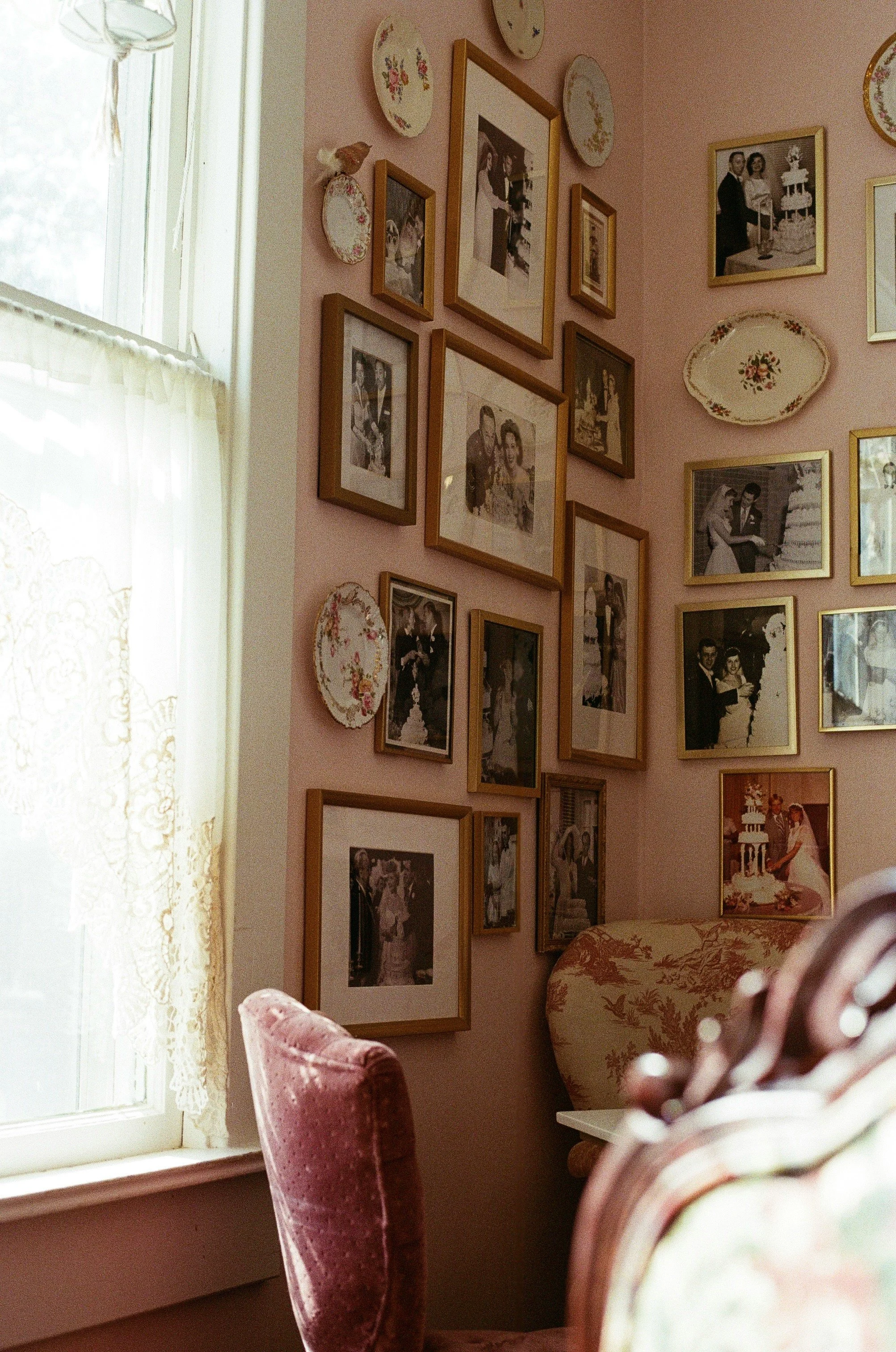
A gallery wall is one of the best ways to make your home feel personal; it’s an ever-evolving lifelong collection. Instead of decorating with a set of perfectly matching pieces, you can bring together artwork, photographs, prints, objects, and meaningful mementos that tell your story.
But creating (and furthermore hanging) a gallery wall can feel overwhelming…. How far apart should the frames be? Do the frames need to match? How do you know which pieces belong together?
The good news is that there isn't one right way to create a gallery wall, and at the end of the day, it should bee FUN. With a few simple guidelines, you can create an arrangement that feels intentional while still reflecting your personal style.
Start With the Art You Already Love
Before buying anything specifically for your gallery wall, look around your home. You may already have more pieces than you realize: family photographs, artwork you've collected, children's drawings, vintage prints, travel souvenirs, postcards, textiles, or other objects with sentimental value. A gallery wall doesn't have to be made entirely of fine art. The most interesting gallery walls often combine different types of things. Think about what you want your wall to say about you rather than trying to recreate something you've seen online.
Choose a Starting Point
If you're working with several pieces, choose one or two that will anchor the arrangement. Visually, it should be the largest or “loudest” pieces of a collection. Like a sun and its’ planets, place the anchor pieces roughly where you want the center of your arrangement to be, then build around it with smaller pieces. If you are looking to custom frame a few pieces for your gallery wall, the anchor piece may give you guidance as to what direction you should go in, stylistically. Starting with your largest or most important piece can make the rest of the layout much easier to determine.
Do Gallery Wall Frames Have to Match?
No!
One of the best things about a gallery wall is that your frames don't have to match perfectly. In fact, different styles, colors, sizes and textures are more fun and interesting!
The trick is to create visual connections between the pieces. Maybe several frames share a similar wood tone, the mats have complementary colors, or the artwork itself provides a common thread. A collection can feel cohesive without looking identical.
Varying the sizes is especially important, as it creates movement and keeps the eye traveling around the wall.
Think About Spacing
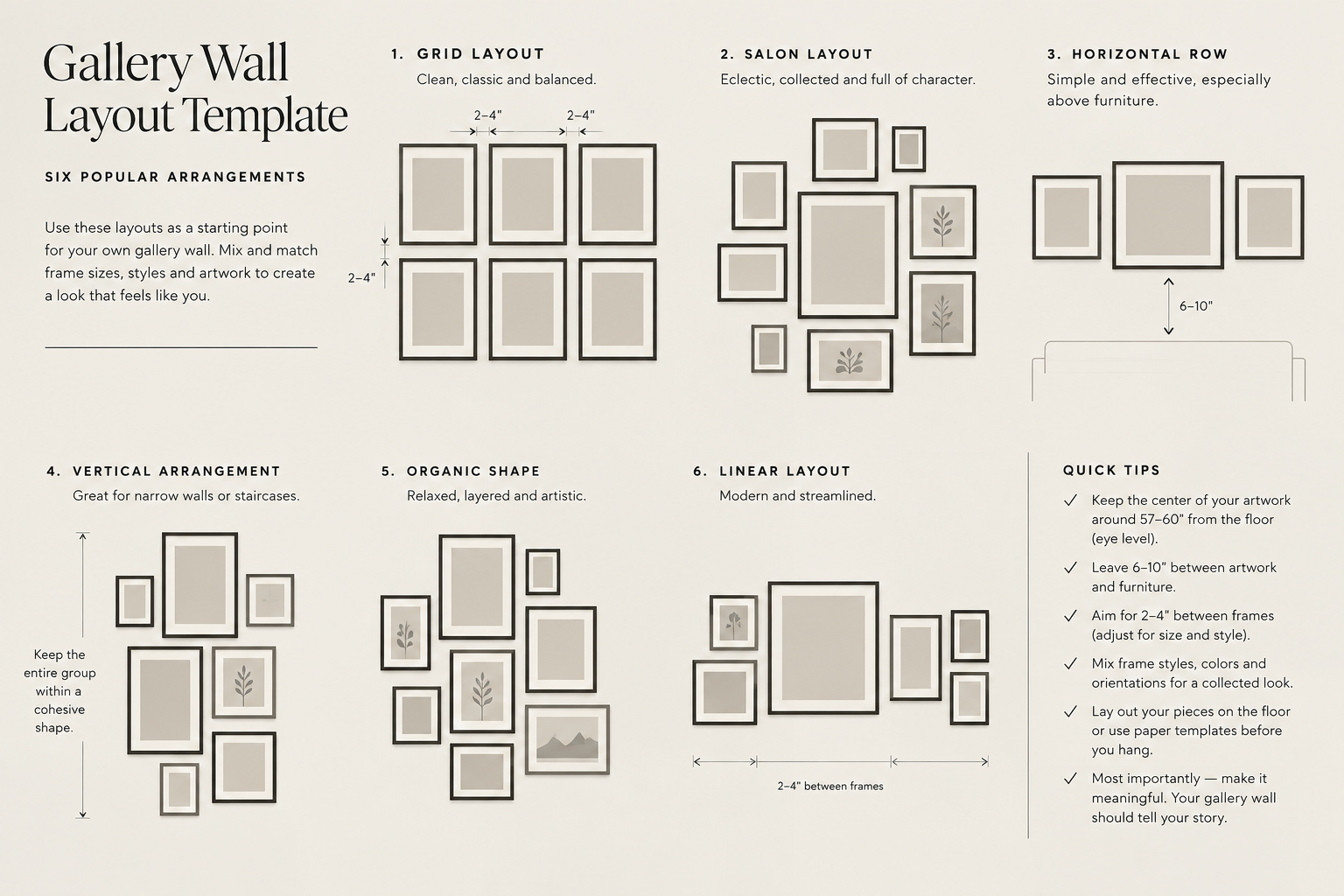
Spacing can make or break a gallery wall. For most arrangements, 2–4 inches between frames is a good starting point. You can use slightly smaller gaps for smaller artwork and slightly larger gaps for larger pieces. The most important thing is consistency. You don't need every measurement to be identical, but the spacing should feel balanced and intentional
Lay Everything Out Before You Hang It
This is one of the easiest ways to save yourself from putting unnecessary holes in the wall. Lay your artwork on the floor and experiment with different arrangements. You can also create paper templates of each frame and tape them to the wall. Using old newspaper or wrapping paper is a great option to make templates. (OR, if you bring your favorite custom framer an iced latte, they might give you some spare kraft paper) This allows you to see the arrangement at full scale before you commit.
Take a step back. Look at the arrangement from across the room. Move things around until the overall shape feels balanced.
Create a Shape
A gallery wall doesn't have to be a perfect rectangle, but it helps to think about the overall shape of the collection and where it will be going in your home. Gallery walls usually look best when they relate to the furniture or architecture around them. Thinking about the overall shape helps prevent the wall from feeling like a random collection of frames. If you're hanging artwork above a sofa, console, or dresser, leave some visual breathing room between the furniture and the artwork. As a general guideline, 6–10 inches between the furniture and the bottom of the frames is a good place to start. Think of the entire collection as one visual unit rather than treating every frame as a separate object. As a visual unit
You might create:
A rectangle:
Great for a more structured, organized look. This might look good in a hallway, in between pillars or bookcases, or in a nook.
A vertical arrangement:
Works well on narrow walls or beside staircases.
A horizontal arrangement:
Perfect above a sofa, console table, or bed.
An organic shape:
Different frame sizes extend outward in a more relaxed, collected arrangement. This works nicely in a dining room where there is often a large, open or blank wall.
Mix Art With Meaningful Objects
Your gallery wall can be about more than artwork. This is where custom framing can make a huge difference. A framer can help determine how to safely mount and display objects that don't fit inside a traditional frame. The result can be much more meaningful than a wall filled with purely decorative art.
Consider incorporating:
Family photographs
Handwritten letters
Children's artwork
Vintage postcards
Textile pieces
Pressed flowers
Concert posters
Maps
Small objects
Heirlooms
Travel memorabilia
Make It Personal and Tell Your Story
The best gallery walls don't necessarily look like they came straight out of a catalog. They look like someone lives there.
Maybe your wall includes a painting you bought from a local artist, a photograph from your wedding, your grandmother's handwritten recipe, and a little print you picked up on vacation. Those pieces don't need to match perfectly because the story connecting them is yours. Creating a gallery wall is ultimately less about following decorating rules and more about bringing together the things you love. Your gallery wall doesn't have to match. It just has to feel like you.
At Artful Framer Studios, we believe custom framing should help you preserve and display the pieces that matter to you. Whether you're starting with one favorite artwork or building an entire collection, we can help you choose frames, mats, mounting methods, and conservation materials that bring everything together. If you are interested in further discussing your gallery wall needs, consider booking a consultation appointment Here